
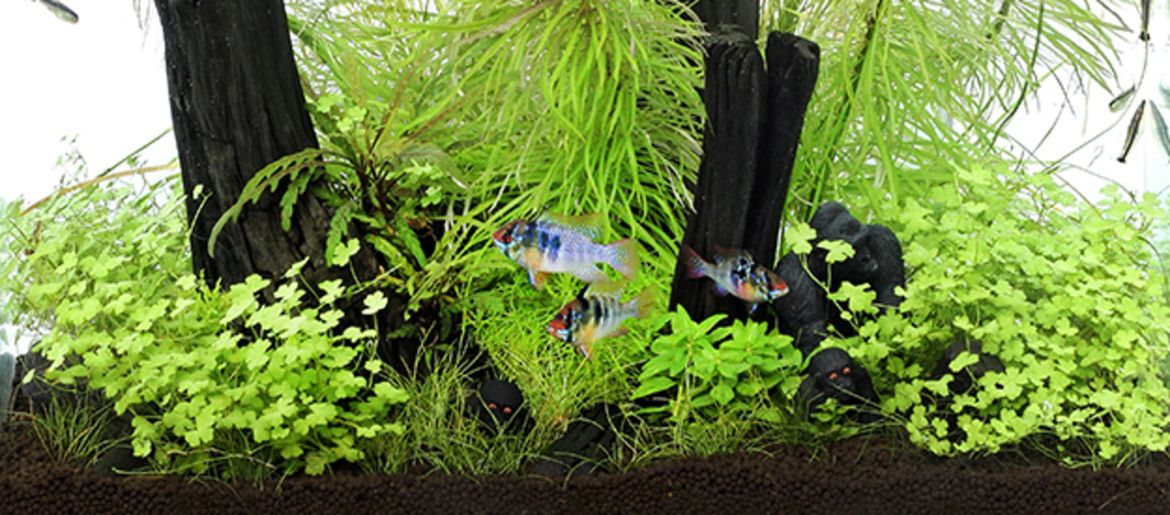
Fertilisation, Light and CO2
Do aquarium plants need to be fertilised?
Fertilisation, lighting and CO₂
In an aquarium, plant growth depends on the balance between fertilisation, lighting and the CO₂ content of the water. Aquatic plants can only thrive if all three factors are in harmony. If this balance is disrupted, nutrient deficiencies can occur, often resulting in algae problems.
Liebig’s law of the minimum
Plant growth can be clearly explained using Liebig’s law of the minimum. In simple terms, growth is always limited by the factor that is in shortest supply. For example, if there is insufficient CO₂ in the aquarium, increasing the light intensity will not improve plant growth. Likewise, if nitrate is lacking, adding a CO₂ system will not solve the issue. Even the most efficient CO₂ supply is ineffective if the plants do not receive enough light.
If plants appear weak, develop pale leaves or show thin, elongated growth, the underlying cause should be identified before taking action. A targeted approach is far more effective than making random adjustments.
Two types of aquariums with a focus on livestock
In planted aquariums where the focus is on fish and other animals, less demanding plant species are usually chosen. Moderate fertilisation and medium lighting are typically sufficient. In well-stocked aquariums with regular feeding, an additional CO₂ system is often not essential. The CO₂ produced naturally by fish, microorganisms and plants is usually adequate for undemanding species, provided that lighting and fertilisation are balanced.
Even in such aquariums, plants play an important role. They absorb nitrogen compounds that could otherwise become harmful, produce oxygen and provide structure, shelter and visual appeal.
Fertilisation
In aquariums focused on livestock, a universal fertiliser such as Plant Elixir by Dennerle can supply essential trace elements. In cases of iron deficiency, which is indicated by pale leaves and light shoot tips, a targeted iron supplement such as E15 FerActiv is recommended. If plant growth remains limited, a more comprehensive fertiliser such as V30 Complete can be used to provide additional nutrients often lacking in tap water.
S7 VitaMix by Dennerle supports not only plants but also beneficial microorganisms in the filter and substrate, which play a crucial role in nutrient cycling and water quality. The Perfect Plant System Set combines these components into a coordinated fertilisation system.
Plants with strong root systems, such as Cryptocoryne or Echinodorus, benefit from root fertilisation. Products such as NutriBalls or PowerTabs can be inserted into the substrate near the roots to provide nutrients directly where they are needed. This method is particularly useful in shrimp aquariums, as it limits nutrient availability in the water column and therefore reduces the risk of algae growth.
Lighting
In these aquariums, lighting can be kept at a moderate level. Energy-efficient solutions such as Trocal LED or fluorescent lighting are suitable. With LED systems, intensity should be set to a medium level, or the lighting duration limited to around 8 to 10 hours per day. If algae appear, adjustments to fertilisation or a slight reduction in lighting can help restore balance.
CO₂
Additional CO₂ can be used to enhance plant growth, even in aquariums focused on livestock. This can be supplied via a bio CO₂ system or a pressurised system. It is important to monitor CO₂ levels to ensure the well-being of the animals. A concentration of up to 20 mg per litre is generally considered safe. Permanent tests, such as the glass CO₂ indicator or the Correct and pH long-term test by Dennerle, make monitoring straightforward.
Two types of aquariums with a focus on plants
In contrast, plant-focused aquariums such as Dutch-style tanks or aquascapes place plants at the centre of attention. These setups often feature demanding species, including red plants or those with unusual growth forms. The aim is to achieve optimal plant health and appearance, often under intensive conditions.
Livestock in such aquariums is usually limited to a few species that help control algae or provide subtle visual accents. As a result, the natural input of nutrients and CO₂ from animals is relatively low.
Fertilisation
In plant-focused aquariums, deficiencies in macronutrients such as nitrate, phosphate and potassium can occur quickly. A complete fertilisation approach is therefore essential. Scaper’s Green by Dennerle is a suitable option for aquariums with strong lighting and dense planting and can be used either daily or weekly.
Root feeding can also be applied where necessary, particularly if signs of deficiency appear in root-feeding plants.
Lighting
Lighting can be more intense in these aquariums. With sufficient nutrients and CO₂, plants can utilise higher light levels effectively, resulting in compact and vigorous growth. A lighting duration of 10 to 12 hours per day is common, sometimes with a short break to support plant metabolism.
CO₂
A reliable CO₂ supply is essential in heavily planted aquariums. Under strong lighting and intensive fertilisation, plants require a consistent supply of carbon dioxide. Levels of up to 30 mg per litre may be used in such systems, provided that only tolerant livestock is present. Otherwise, maintaining around 20 mg per litre remains the safer option.
Enjoy your aquarium!
Latest reviews
-

JBL Zanzibar SNOW, 5kg
- Very fine sand for all aquarium types
- Soil with 0.1-0.6 mm grain size
- For fresh and saltwater and terrariums
-
Seachem Flourite Black Sand, 7 kg
- For planted aquariums
- Not chemically treated or coated
- Doesn't need to be replaced
-
Olibetta Dragon Rocks - 5 KG, 5 kg
- Does not harden the water
- Natural rocks with a fantastic texture
- ideal for planting
-
Olibetta Red Moorwood, L
- Beautiful driftwood - real wood!
- For freshwater aquariums and terrariums
- Rich in fibre, important for catfish and invertebrates
Magazine Articles:
Discover Olibetta:
-
Ireland: Free standard delivery from € 87,90
-
Free
returns -
We operate in a
climate-conscious manner. More than 6.000 products